What Is a System One Model? TypeSafe's Approach Explained
What is a System One model? Learn how TypeSafe AI's Jev turns software state into typed, probabilistic decisions—and how it differs from structured-output LLMs.
Most AI models are built to produce something people can read.
Write an email. Summarize a document. Generate code. Answer a question.
Software often needs something else: a decision.
Should this support ticket go to billing or technical support? How severe is this incident? Does this request require human review? Which workflow should run next?
TypeSafe AI's System One models are designed around those decisions. Its first public model, Jev, was announced in September 2026 as a model that takes application state and typed questions and returns structured decisions with probabilities.
The distinction isn't simply that Jev returns structured data. LLMs can already produce JSON and other schema-constrained outputs. TypeSafe's approach goes further by designing the model's architecture, sampling process, and training objective around software decisions.
What Is a System One Model?
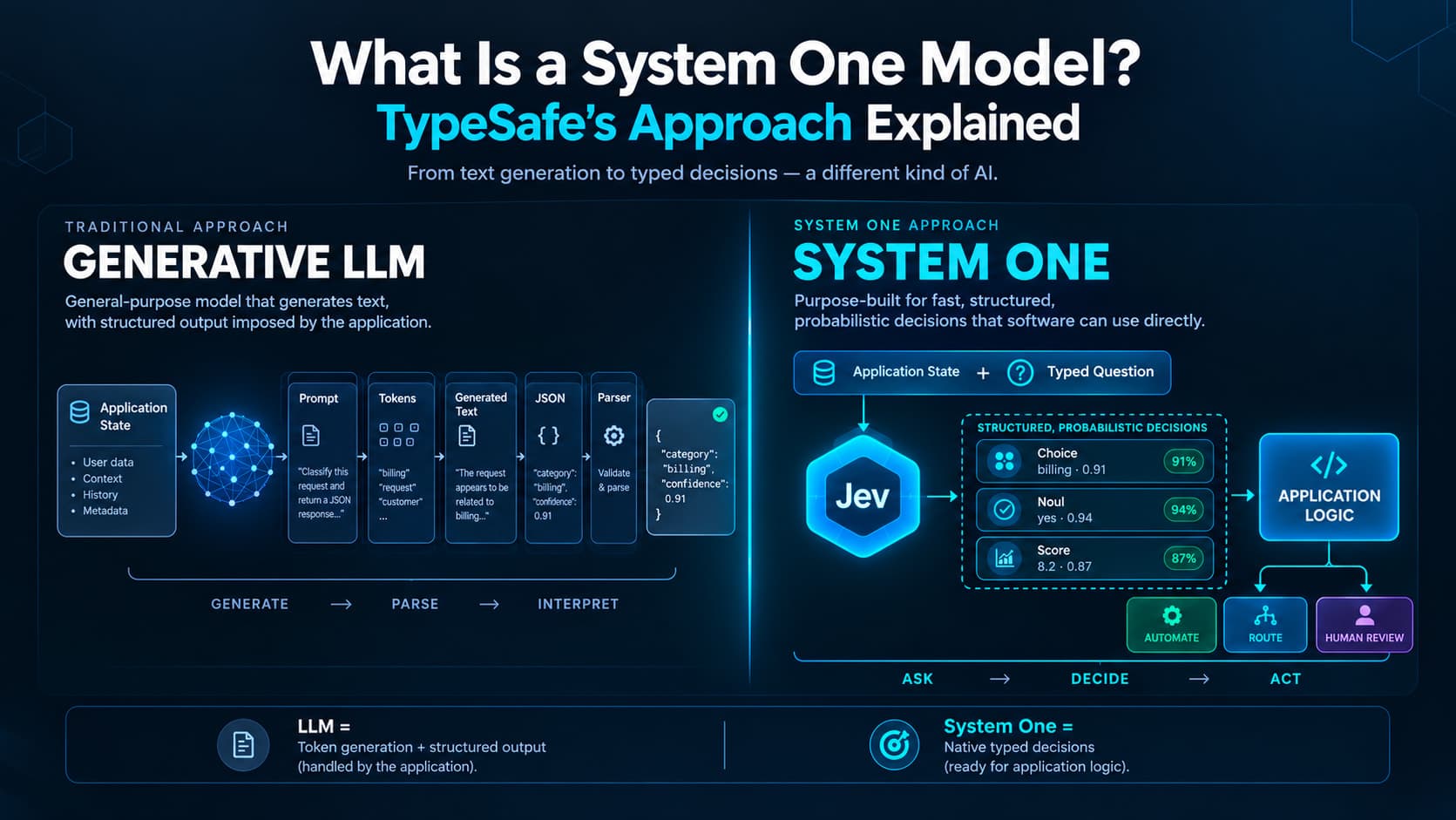
A System One model is TypeSafe's term for an AI model designed to make fast, structured decisions that software can use directly. TypeSafe describes the interface as "unstructured state in, typed probabilistic decisions out."
A typical request might look like:
Choice: Which team should handle this ticket?
Score: How severe is this incident?
Noul: Is the customer asking for a human agent?
The application defines the question and its valid answer format. The model evaluates the supplied state and returns a decision plus confidence information.
TypeSafe currently exposes those three decision primitives through its API: Noul for yes/no questions, Choice for selecting among options, and Score for assigning a value on an ordered scale.
How Is Jev Different From a Structured-Output LLM?
This is where Jev's positioning gets more specific.
A conventional LLM can be prompted to classify a support ticket and return JSON:
{
  "category": "billing",
  "confidence": 0.91
}
That works for many applications. But the underlying model is still generating a sequence of tokens. The structured format is imposed on a general-purpose generative system.
TypeSafe is taking the opposite approach. Its published comparison says Jev produces predefined typed values rather than strings, uses parallel sampling rather than sequential token generation, and includes calibrated probabilities with its decisions.
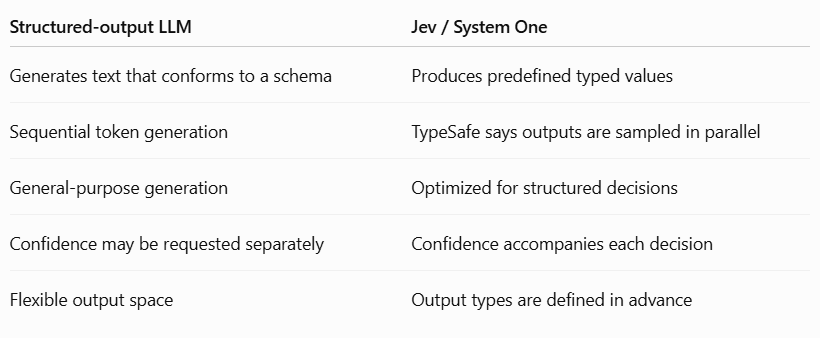
This can also reduce generation and parsing overhead in applications that only need a decision, although the amount saved depends on the integration and workflow.
TypeSafe says Jev's outputs are "type-safe" and that the model cannot produce type errors. That is a claim about the architecture TypeSafe has built, rather than a general property of AI models.
Why Calibration Matters
For software, a probability only helps if it tells you something useful about uncertainty.
Suppose an application wants to automate a decision only when the model is sufficiently confident. A probability that is consistently overconfident isn't much help.
TypeSafe says Jev is trained with Reinforcement Learning for Calibrated Decisions (RLCD), an approach it developed specifically for decision-making. The company describes the objective as producing calibrated probabilities rather than optimizing primarily for human preference over generated responses.
That enables a workflow such as:
Incoming state
      ↓
     Jev
      ↓
High confidence → automatic action
Medium confidence → additional processing
Low confidence → human review
The thresholds still belong to the application. A model providing a 95% probability does not mean a company must automatically act on it.
A Concrete Example
Imagine an online retailer receives this support request:
"My order arrived with the wrong item, and I need the replacement before Friday."
The application already has the customer's message, order information, shipping status, and account history.
Instead of asking an LLM to decide everything in one prompt, the workflow could ask Jev several narrow questions:
Choice:
Which issue category applies?

- shipping
- returns
- billing
- product

Noul:
Is the request time-sensitive?

Noul:
Does this case require human intervention?

Score:
How frustrated is the customer?
Jev can evaluate multiple questions against the same state. TypeSafe's workflow evaluations use this decomposition approach: break an automation task into narrower questions and let ordinary code handle the deterministic parts.
The application might then implement rules such as:
if time_sensitive > 0.90:
    prioritize_ticket()

if human_required > 0.80:
    send_to_human()

if category == "returns":
    use_returns_workflow()
That separation captures TypeSafe's idea better than the usual "AI classifier" framing. The model supplies judgments; application code decides what those judgments mean operationally.
Where Jev Fits Alongside an LLM
System One models aren't necessarily intended to replace generative models.
An application could use an LLM for the parts that require language generation while using Jev for smaller decisions around it.
For example:
Customer message
       ↓
      Jev
       ↓
Urgency / routing / review checks
       ↓
Application code
       ↓
LLM / tools / human
The LLM can write the eventual response. Jev can handle the decision points that determine which workflow should run.
That architecture is particularly relevant when those decisions happen thousands or millions of times and the application needs predictable output types and explicit uncertainty.
For businesses considering this kind of architecture, successful AI implementation also depends on the underlying data, workflows, integrations, and operational requirements.
Why Call It "System One"?
The name is inspired by Daniel Kahneman's distinction between System 1 and System 2 thinking in Thinking, Fast and Slow.
System 1 describes fast, intuitive judgments; System 2 describes slower, deliberate reasoning. TypeSafe uses the terminology as an analogy for a fast decision layer inside software, not as a claim that Jev reproduces human cognitive processes.
What System One Models Are Good At
The approach is most relevant when an application repeatedly needs a defined kind of judgment inside an AI workflow automation system.
Examples include:
Ticket routing
Security-alert triage
Invoice processing
Content classification
Risk scoring
Agent quality checks
Workflow gates
Tool or action selection
TypeSafe's own workflow evaluations focus on this pattern: decompose a task into independent intelligent judgments, use programmatic rules where possible, and combine the results into a larger workflow.
It is less relevant when the desired output is itself language. If the application needs a report, explanation, code, or conversational response, a generative model remains the natural choice.
The Technical Trade-Off
Jev's specialization is also its limitation.
It gives up the flexibility of free-form generation in exchange for an interface designed around structured decisions. TypeSafe says its architecture, parallel sampler, and RLCD training method were built specifically for this automation-oriented workload.
TypeSafe also publishes aggressive performance comparisons for Jev, including claims of substantially lower latency and cost on its System One workflow evaluations. Those figures are TypeSafe's own measurements, and the company publishes methodological caveats alongside them, including the choice of reference models and the fact that its team created the workflows.
That makes the architectural idea easier to separate from the marketing numbers.
The core proposal is straightforward: instead of forcing every AI interaction through a text-generation interface, build a model whose native job is to make the small, uncertain judgments that software repeatedly needs.
For businesses building these kinds of systems, the challenge is usually not choosing a model in isolation, but integrating AI into the workflows and software the business already uses.
Classification itself isn't new. The bigger idea is making the decision a first-class part of the software interface.
You Might Also Like
10 Important Things to Know About System One Models and TypeSafe’s Jev