
AI Implementation for Real Estate Companies: A Roadmap from Pilot Projects to Enterprise Growth
Learn how real estate companies can implement AI successfully with a practical roadmap covering strategy, data, governance, pilots, scaling, and ROI.
Most real estate companies are not struggling to start their AI journey.
They are struggling to move beyond the first experiment.
According to JLL’s 2025 Global Real Estate Technology Survey, nearly 90% of real estate investors, landlords, and occupiers are already running AI pilots. Yet only around 5% have fully achieved the goals they originally set for those initiatives.
That gap tells an important story.
The challenge is no longer convincing executives that AI matters. The challenge is turning promising demonstrations into systems that improve decision-making, reduce operating costs, and create measurable business value.
A property team may successfully test an AI tool that summarizes leases. An investment team may experiment with automated market analysis. A customer service team may deploy an AI assistant.
But what happens next?
How does that pilot become part of the company’s daily operations?
How does AI move from a technology experiment to an enterprise capability?
That is where most companies need a different approach.
AI implementation for real estate is not about buying another software platform. It is about redesigning how the business captures information, makes decisions, and delivers value.
Companies that succeed will not necessarily be the ones with the most AI tools. They will be the ones that build the right foundation to use AI consistently across the organization.
This guide explains the practical AI roadmap real estate leaders need to move from experimentation to enterprise adoption.
What Is AI Implementation for Real Estate?
AI implementation for real estate is the process of integrating artificial intelligence into real estate operations to improve productivity, decision-making, customer experience, and financial performance.
In practical terms, it means using technologies such as machine learning, generative AI, computer vision, and predictive analytics across activities like:
Property valuation
Lease analysis
Tenant communication
Market research
Investment decisions
Maintenance planning
Lead management
Portfolio optimization
However, successful implementation is not simply about adding AI tools to existing processes.
A company that automates a broken process usually creates a faster broken process.
The strongest AI programs start by identifying expensive business problems, preparing reliable data, establishing governance, and then selecting technology that supports those goals.
As McKinsey has noted, real estate is a data-rich industry, but much of that data remains trapped inside documents, emails, spreadsheets, and disconnected systems. The opportunity comes from turning that unused information into better decisions.
Why Are Real Estate Companies Struggling to Scale AI?
The Problem Is Not AI Adoption. It Is AI Execution.
Many executives assume the biggest challenge will be finding the right AI technology.
In reality, the harder questions are usually:
Do we know which problems AI should solve first?
Is our data reliable enough?
Are teams prepared to change existing workflows?
Can we measure business impact?
Who owns AI decisions across the company?
A successful AI pilot can create excitement. But excitement does not create enterprise value.
Consider a common example.
A commercial real estate firm launches an AI tool that extracts key information from lease agreements. The pilot works well because the team provides a small set of clean documents.
Leadership decides to expand it across the entire portfolio.
Then problems appear.
Different properties store leases differently. Some documents are scanned PDFs. Others contain outdated terms. Naming conventions vary between departments.
The AI tool was not the problem.
The business was not ready to scale it.
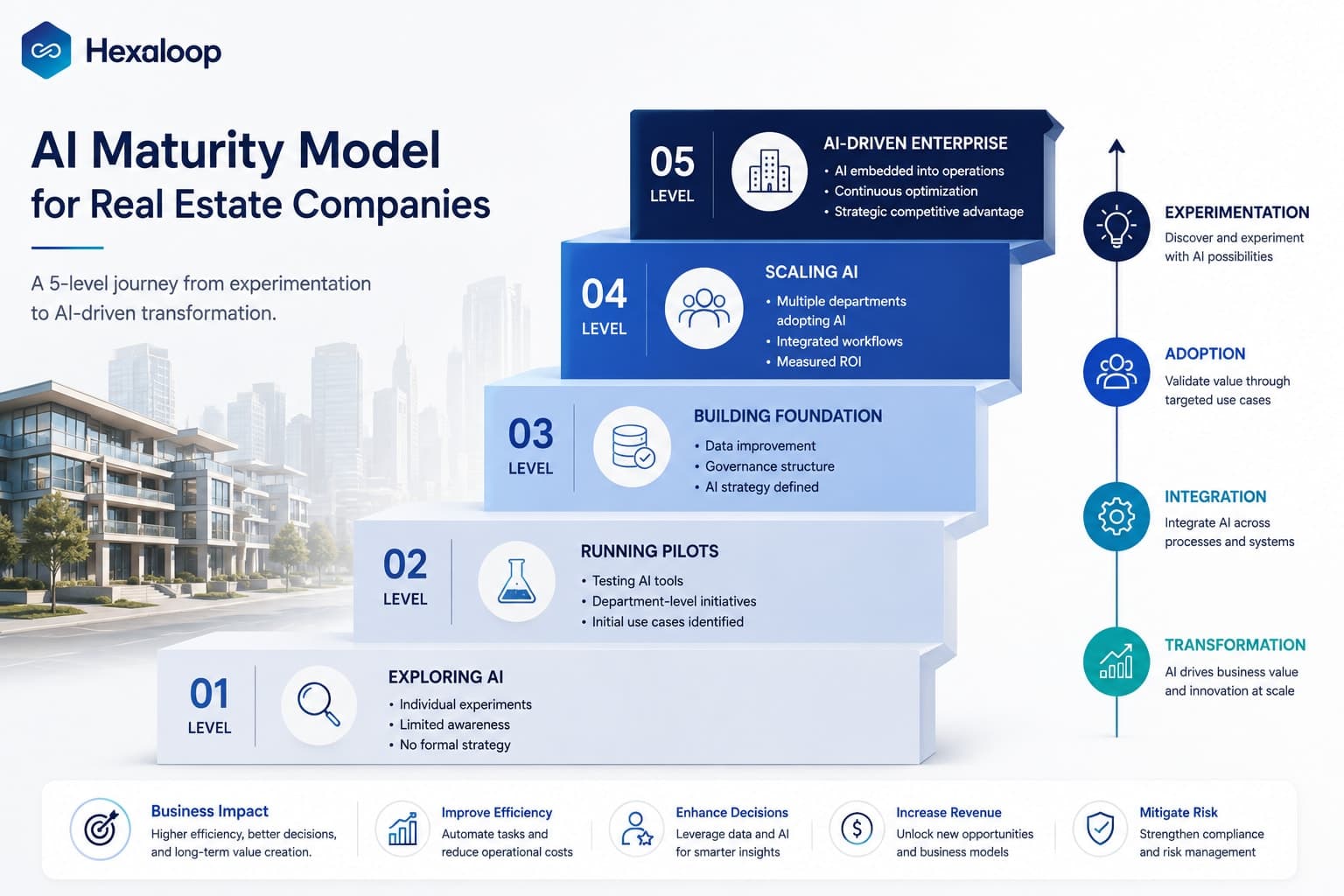
This is why many organizations get stuck in what executives often call "pilot purgatory." They continue testing AI solutions without creating the foundation required for enterprise adoption.
Research from IDC, MIT, and other enterprise technology studies highlights this challenge. A significant percentage of AI proofs of concept never reach full production because companies underestimate data readiness, workflow integration, and change management.
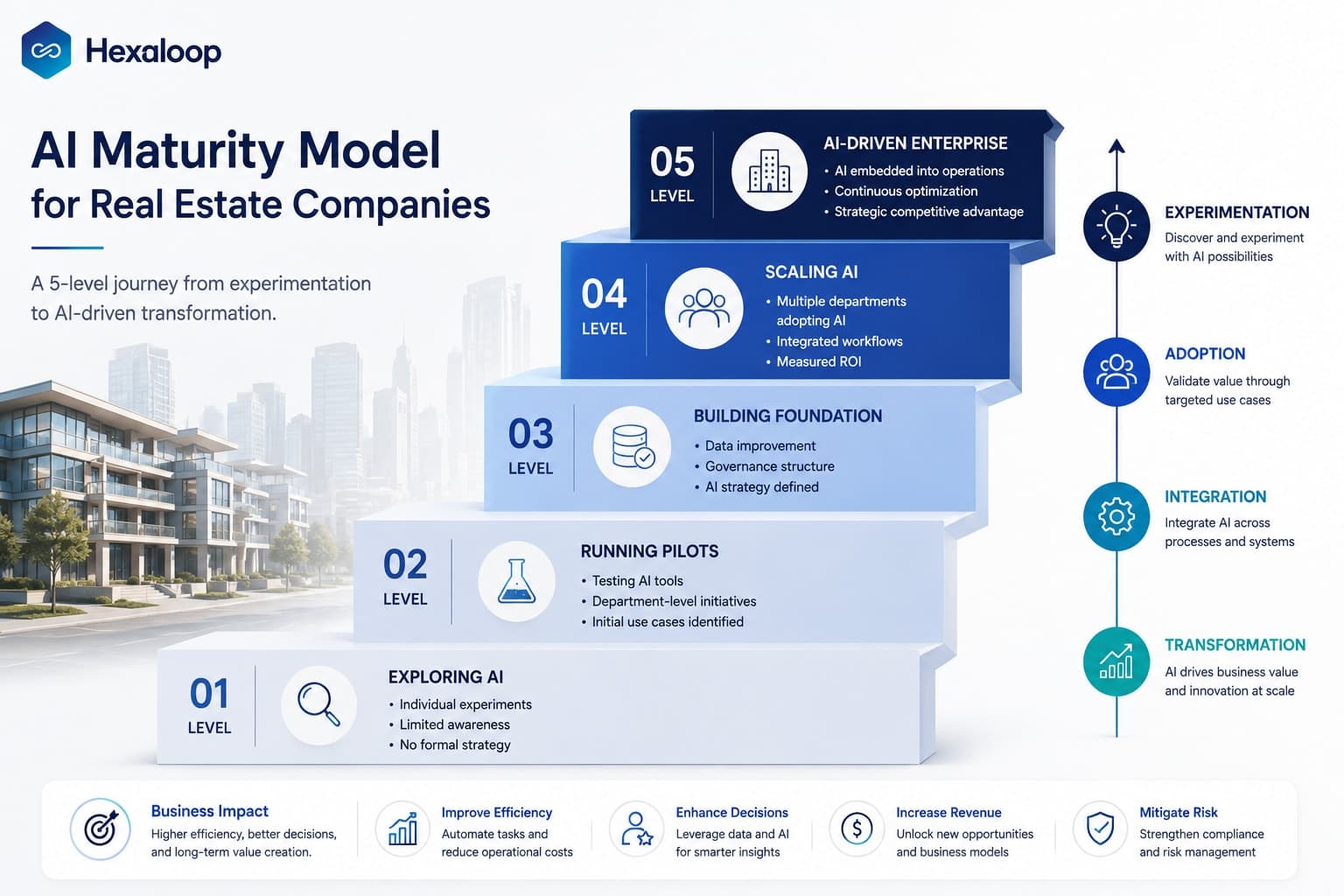
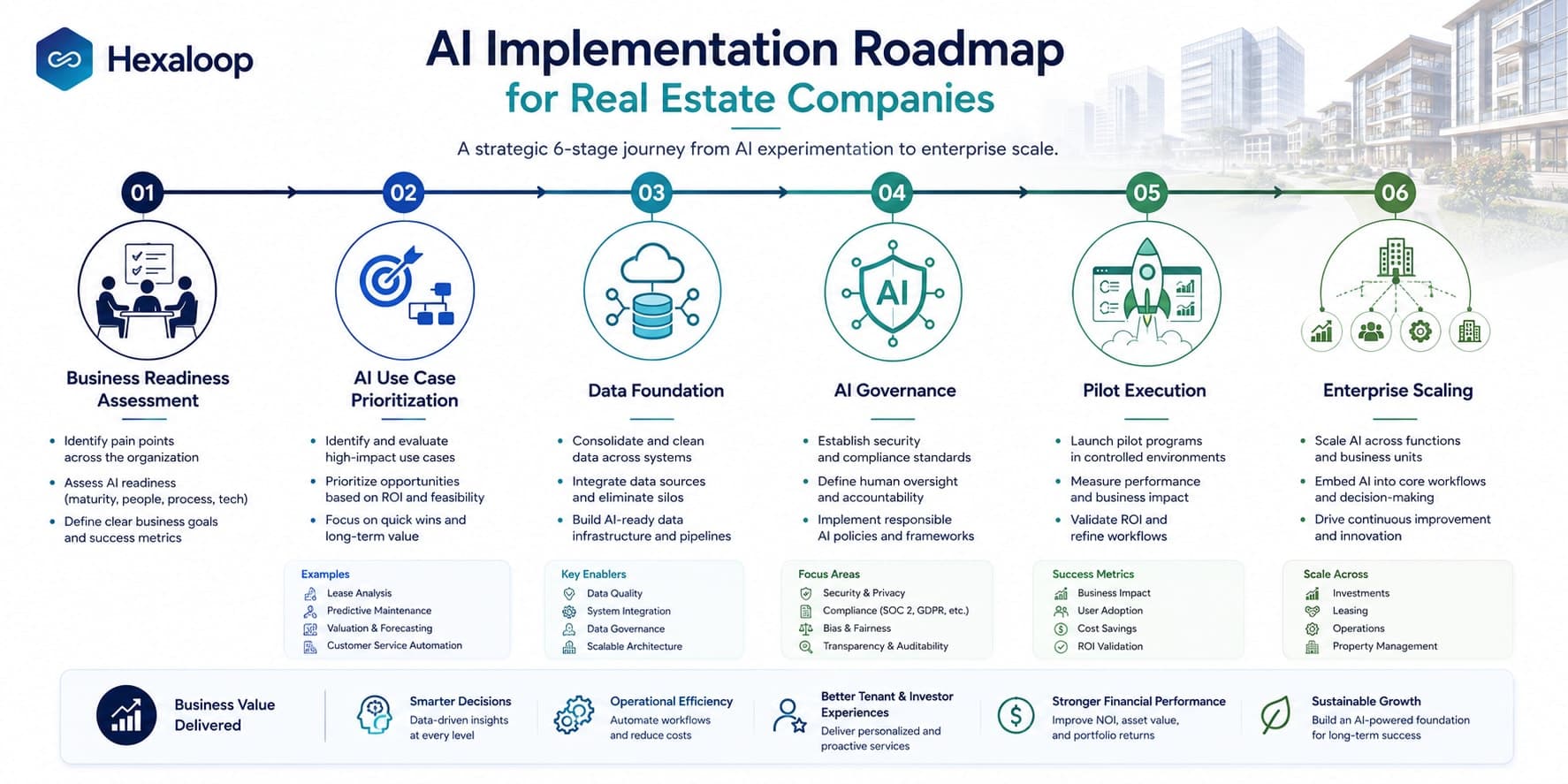
The AI Implementation Roadmap for Real Estate Companies
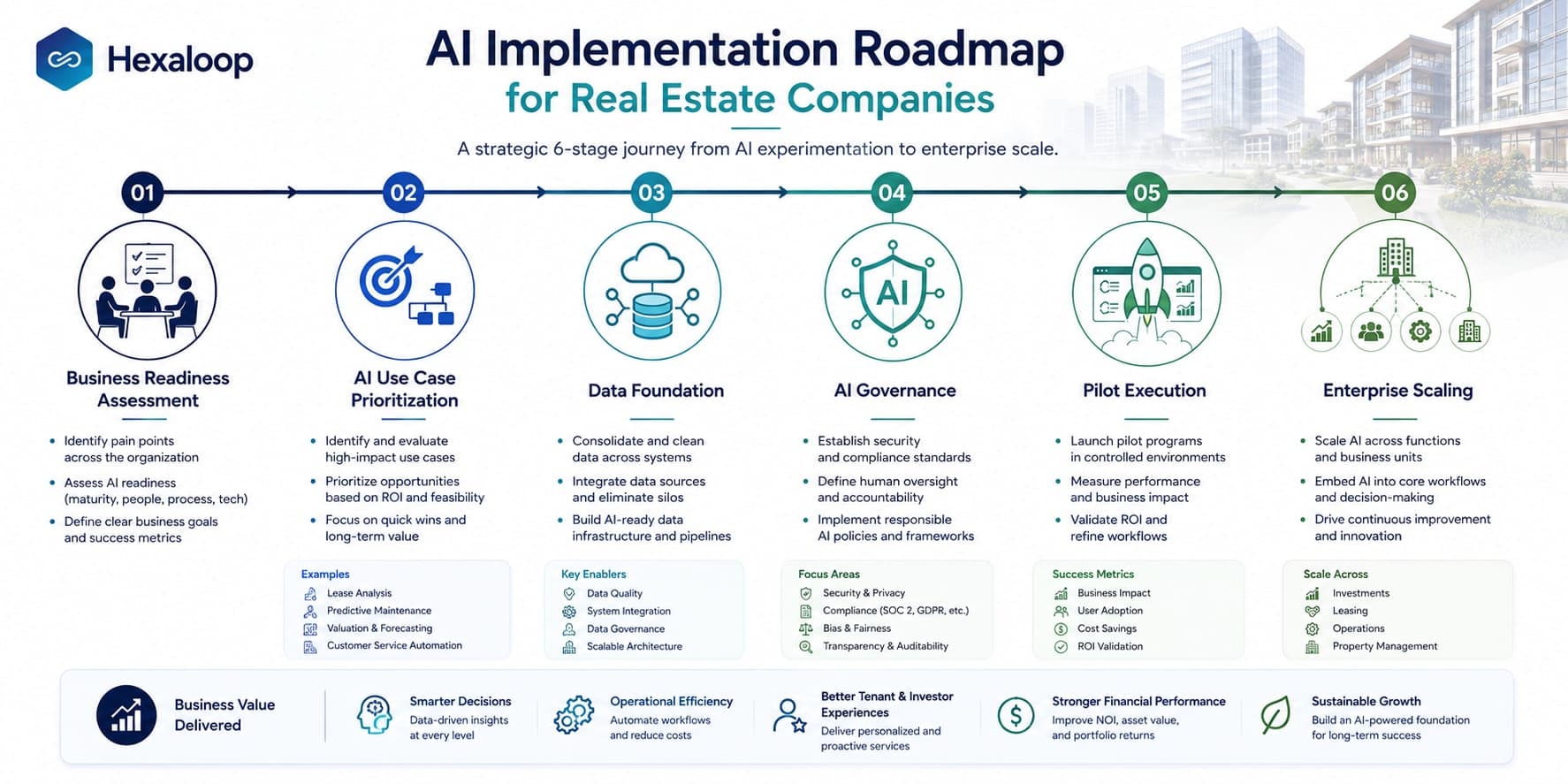
A practical AI roadmap has six stages:
Business readiness assessment
Use-case prioritization
Data preparation
AI governance
Pilot execution
Enterprise scaling
Each stage solves a different problem.
Skipping one usually creates issues later.
Phase 1: Assess Business Readiness Before Investing in AI
Before selecting AI platforms, executives need to understand where the business stands today.
This is where many companies make their first mistake.
They start with technology.
They attend demonstrations, compare vendors, and purchase tools before identifying the business problems they actually want to solve.
A better approach begins with operational reality.
Ask:
Where are employees spending hours on repetitive work?
Which processes delay revenue generation?
Where are decisions slowed because information is difficult to access?
Which workflows depend heavily on manual review?
For a real estate company, the biggest opportunities often appear in areas where teams handle large amounts of information.
Examples include:
Reviewing hundreds of lease agreements during acquisitions
Preparing investment reports
Responding to tenant requests
Analyzing market opportunities
Managing maintenance operations
The purpose of a readiness assessment is not to find every possible AI opportunity.
It is to identify where AI can create measurable business improvement.
Phase 2: Define AI Use Cases That Matter to the Business
The best AI initiatives solve expensive problems.
Not interesting problems.
A common mistake is selecting AI projects because the technology looks impressive. Executives become attracted to sophisticated solutions without asking whether they improve the business.
A stronger approach is to rank opportunities based on:
Business impact : Will this improve revenue, cost, or efficiency?
Data availability : Do we have the information required?
Complexity : Can we realistically implement this?
Adoption potential : Will employees actually use it?
Measurement : Can we prove the outcome?
For example, an AI-powered property search assistant may sound exciting, but if the company has inconsistent property data across systems, the results may disappoint.
Meanwhile, automating lease abstraction may deliver faster value because the business already has a clear process, measurable workload, and defined output.
The best first project is usually not the most advanced AI application.
It is the one where success can be clearly demonstrated.
Real Estate AI Use Cases With Strong Business Potential
Lease Analysis and Document Intelligence
Real estate companies manage enormous amounts of contractual information.
AI can help extract:
Lease dates
Renewal options
Escalation clauses
Tenant obligations
Financial terms
This reduces manual review time and allows teams to focus on higher-value analysis.
Predictive Property Maintenance
Traditional maintenance is often reactive.
Something breaks. Someone reports it. The team responds.
AI changes this approach by identifying patterns before failures occur.
Prologis has explored AI-driven approaches using computer vision and predictive analytics to improve industrial property maintenance. By identifying issues earlier, companies can reduce repair costs and extend asset life.
The lesson is simple:
AI creates value when it improves an existing operational process.
Not when it is added just because the technology exists.
Phase 3: Audit and Improve Data Quality Before Scaling AI
If there is one lesson that separates successful AI programs from failed experiments, it is this:
AI performance is limited by the quality of information it receives.
Real estate companies often have valuable data, but that data is rarely organized for AI.
A typical enterprise may have:
Lease documents stored across different folders
Property information spread across multiple systems
Customer records with inconsistent formats
Maintenance histories that are incomplete
Market research stored in PDFs and spreadsheets
For humans, experienced employees can often connect these dots because they understand the business context.
AI does not work that way.
It needs structured, accessible, and reliable information.
Gartner research has highlighted data quality as one of the biggest reasons AI projects fail. Having data is not enough. Companies need AI-ready data, meaning information that is clean, properly organized, accessible, and governed.
This is where many real estate companies underestimate the work involved.
They think AI implementation starts when they select a tool.
It actually starts when they prepare the foundation that allows the tool to perform.
What Does AI-Ready Data Look Like?
AI-ready data should be:
Accurate
Information should reflect the current business reality.
Outdated tenant records or incorrect property details can create unreliable AI outputs.
Accessible
Teams and AI systems should be able to retrieve relevant information without searching through disconnected databases.
Consistent
Property names, financial terms, and operational categories should follow common standards.
Secure
Sensitive information must have proper access controls and permissions.
A company that invests in data preparation today creates more flexibility for future AI applications.
Phase 4: Build AI Governance Before Enterprise Adoption
Many executives think governance slows innovation.
In reality, good governance allows companies to scale AI with confidence.
Without clear guidelines, different departments may purchase separate AI tools, upload sensitive information into unapproved platforms, or use AI-generated insights without proper review.
That creates unnecessary risk.
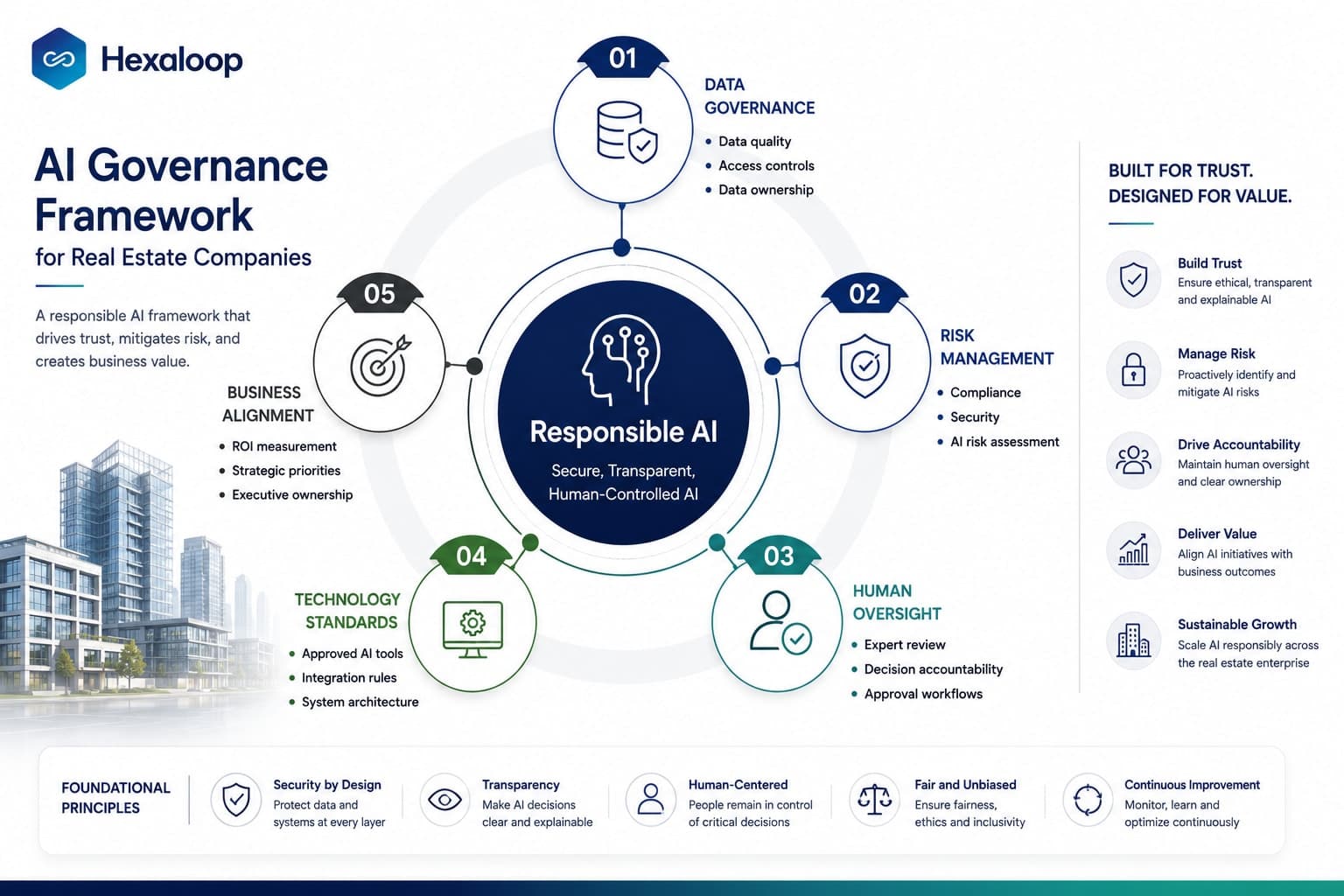
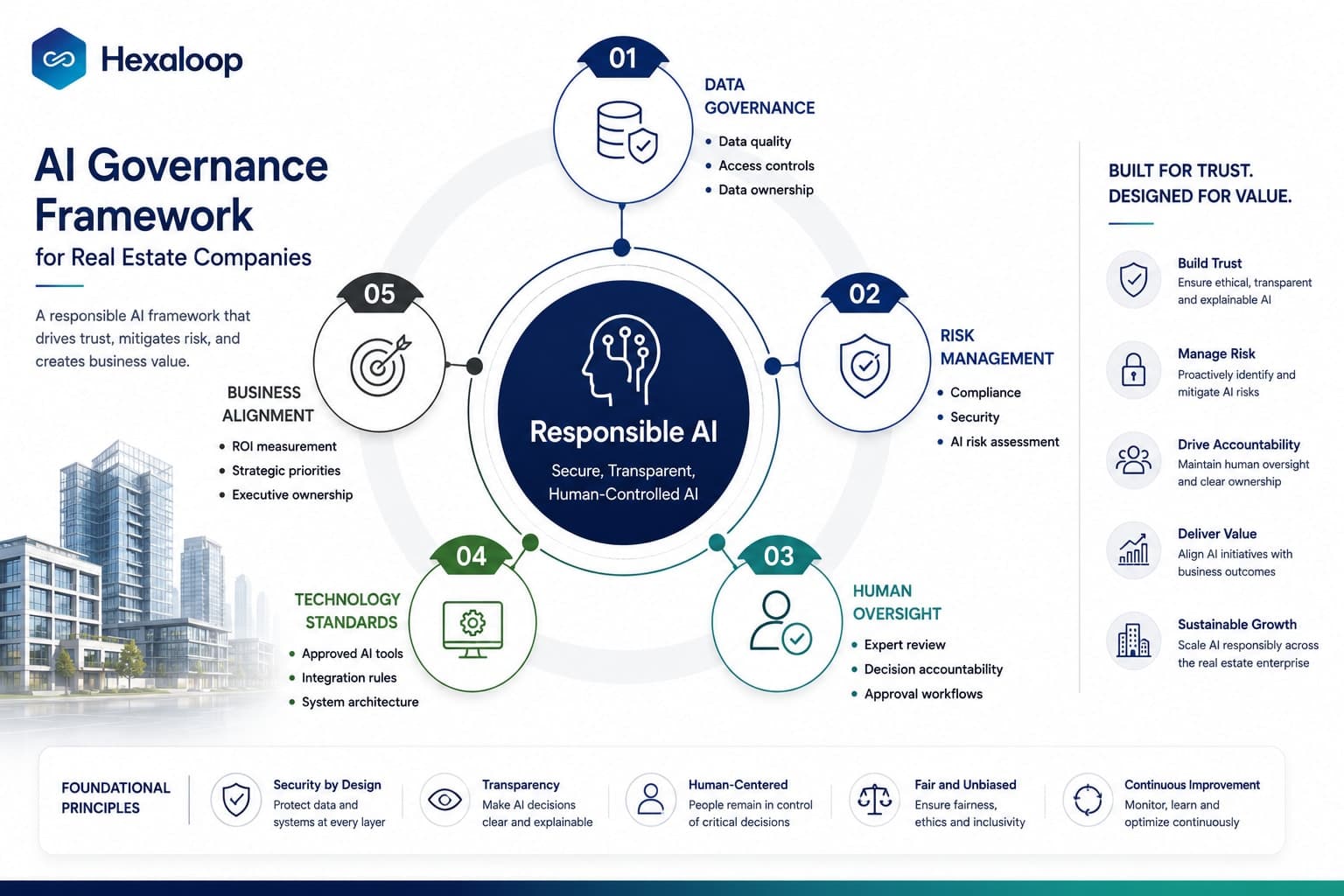
An enterprise AI governance framework should answer:
Who approves AI use cases?
Which data can AI systems access?
Where is human review required?
How will AI decisions be monitored?
How will security and compliance be maintained?
A practical governance team usually includes leaders from:
Technology
Legal
Operations
Finance
Business units
Risk management
The purpose is not to create bureaucracy.
The purpose is to make sure AI supports business goals safely and consistently.
Phase 5: Select the Right AI Technology Stack
Technology selection should come after business strategy and data preparation.
This sounds obvious, but many companies still approach AI backwards.
They begin with a vendor presentation.
Then they search for a problem that fits the technology.
A better approach starts with business needs.
When evaluating AI platforms, consider:
Integration Capability
Can the solution connect with existing systems such as:
CRM platforms
Property management systems
ERP systems
Document repositories
Data warehouses
An AI tool that operates separately from core workflows usually creates limited long-term value.
Scalability
A solution that works for one department may not work across thousands of properties or multiple business units.
Executives should consider future requirements before committing.
Security and Compliance
Real estate companies manage sensitive information including:
Financial documents
Tenant information
Investment data
Contracts
Security cannot be an afterthought.
User Adoption
The best technology fails if employees avoid using it.
The right solution should fit naturally into existing workflows.
Phase 6: Run AI Pilots Designed for Expansion
A pilot should not simply prove that AI works.
It should prove that AI can scale.
This is where many companies make another mistake.
They choose small experiments with no connection to larger business goals.
A better pilot has five characteristics:
A clear business problem
Defined success metrics
Available data
A committed business owner
A path toward expansion
For example:
A real estate investment company may start by using AI to analyze acquisition documents for one property category.
The purpose is not only to save analyst time.
The company should also learn:
How accurate are AI outputs?
How much human review is needed?
What data improvements are required?
Can the workflow expand across other asset classes?
A pilot should answer one important question:
Can this become part of how we operate?
Real-World Example: How CBRE Approached AI at Enterprise Scale
CBRE provides an important example of why AI success depends on business foundations.
The company manages enormous amounts of operational and property-related information across global markets.
Instead of focusing only on individual AI tools, CBRE invested in connecting data sources and improving its technology foundation.
The approach focused on:
Integrating operational data
Improving visibility across facilities
Supporting smarter decision-making
Using AI where it could improve productivity
The key lesson is valuable for any real estate company:
Enterprise AI works best when companies solve data fragmentation before attempting large-scale automation.
The technology matters.
But the foundation matters more.
Scaling AI Across Real Estate Departments
A successful pilot is only the beginning.
The next challenge is adoption.
Enterprise AI requires changes across teams, workflows, and decision-making processes.
Different departments may use AI differently.
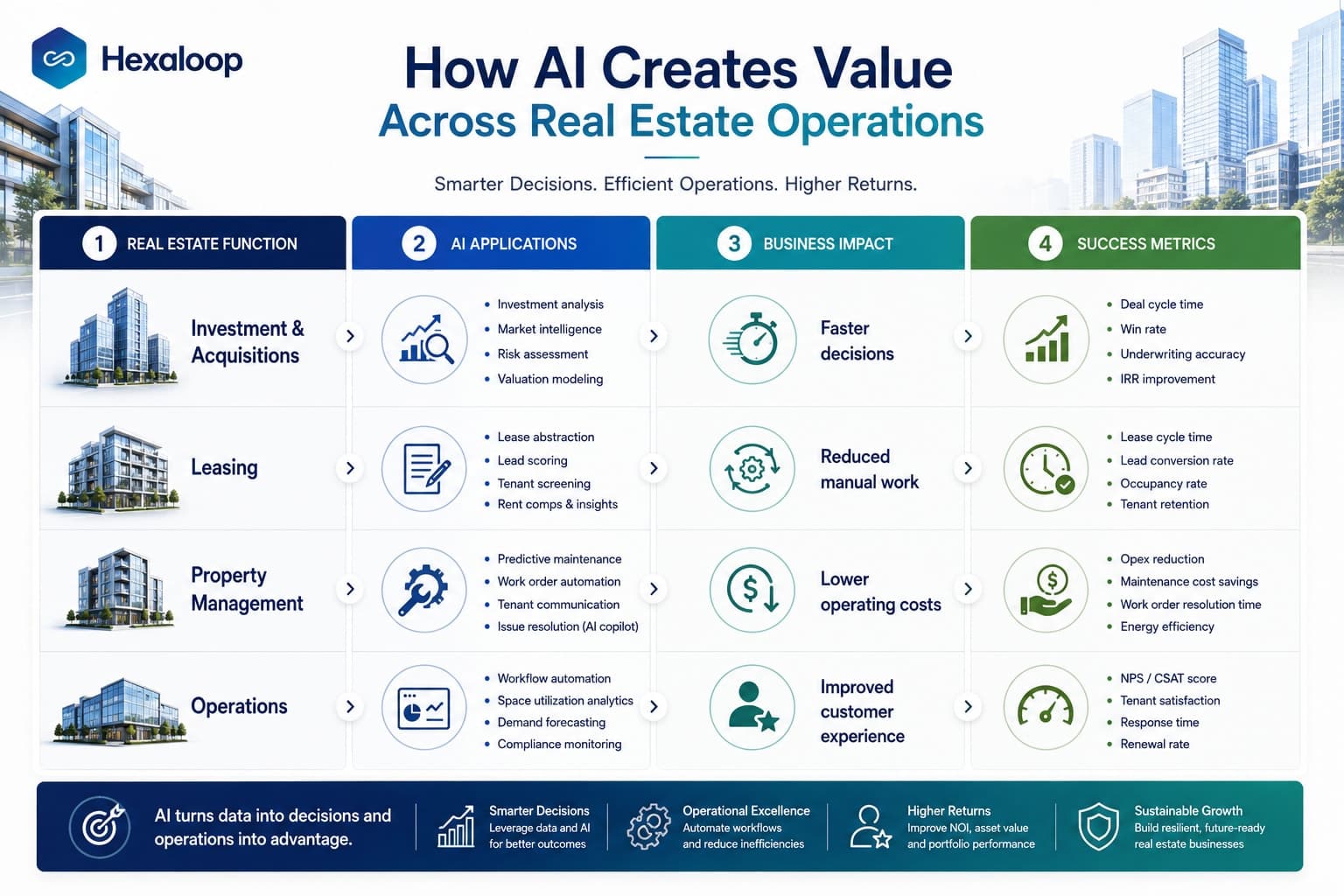
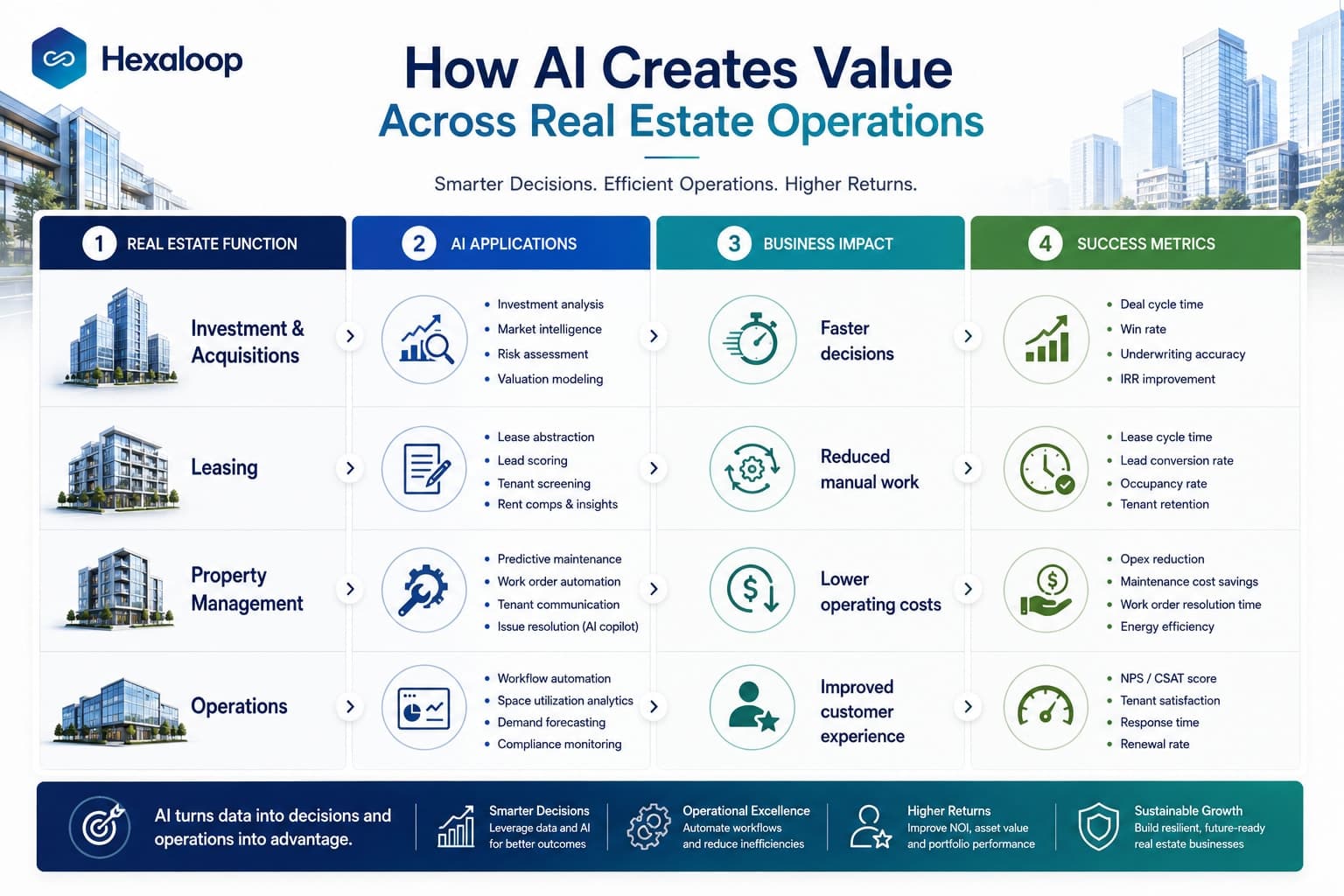
Investment Teams
AI can support:
Market analysis
Due diligence
Opportunity identification
Investment research
Property Management Teams
AI can support:
Maintenance forecasting
Tenant communication
Work order prioritization
Leasing Teams
AI can support:
Lead qualification
Customer responses
Lease analysis
Operations Teams
AI can support:
Energy optimization
Facility monitoring
Resource planning
The important point is not to force every department to use the same AI solution.
Different business problems require different applications.
What should remain consistent is the overall AI strategy, governance, and measurement approach.
Measuring AI ROI in Real Estate
Many AI initiatives fail because companies cannot answer a basic question:
Did this actually improve the business?
Before launching a project, define how success will be measured.
Useful metrics include:
Productivity Improvements
Examples:
Reduction in manual research time
Faster document review
Shorter reporting cycles
Operational Savings
Examples:
Lower maintenance costs
Reduced administrative workload
Improved resource allocation
Revenue Impact
Examples:
Faster deal execution
Better lead conversion
Improved tenant experience
Decision Quality
Examples:
More accurate forecasting
Faster access to insights
Better investment analysis
For example, predictive maintenance should not simply be measured by whether an AI model detects problems.
The real measurement is business impact:
Were repair costs reduced?
Was downtime avoided?
Was asset performance improved?
AI metrics should always connect back to business outcomes.
Common AI Implementation Mistakes Real Estate Companies Should Avoid
1. Buying Technology Before Defining the Problem
AI is not valuable because it is innovative.
It is valuable because it solves expensive business problems.
2. Ignoring Data Problems
Poor data creates poor AI results.
Cleaning and organizing information is not a separate project from AI implementation.
It is part of implementation.
3. Treating AI as an IT Project
AI affects operations, employees, processes, and decision-making.
Technology teams are important, but business leaders must own the transformation.
4. Scaling Too Quickly
A successful pilot does not automatically mean enterprise readiness.
Companies need to understand:
Workflow impact
Training requirements
Governance needs
Integration challenges
before expanding.
5. Failing to Prepare Employees
AI adoption is ultimately a people challenge.
Employees need to understand:
Why AI is being introduced
How it helps their work
When human judgment is required
How success will be measured
How Long Does AI Implementation Take in Real Estate?
There is no universal timeline.
The duration depends on:
Company size
Data maturity
Number of systems involved
Complexity of use cases
Change management requirements
A practical enterprise approach often looks like:
First 30 Days
Assess readiness
Identify opportunities
Define priorities
Establish governance
30 to 90 Days
Launch focused pilot
Measure results
Improve workflows
3 to 18 Months
Integrate AI into core systems
Expand across departments
Build long-term AI capabilities
The companies that move fastest are usually not the ones that skip steps.
They are the ones that remove uncertainty early.
Frequently Asked Questions About AI Implementation for Real Estate
What is AI implementation for real estate?
AI implementation for real estate is the process of applying artificial intelligence technologies across real estate operations to improve efficiency, decision-making, customer experience, and business performance.
Why do AI projects fail in real estate?
Most failures happen because companies focus on technology before preparing their data, processes, and employees. Poor data quality, unclear goals, and weak adoption strategies are common causes.
What should real estate companies do before implementing AI?
Companies should assess business readiness, identify high-value use cases, improve data quality, establish governance, and define success metrics before selecting AI tools.
What are the best AI use cases in real estate?
Common high-value applications include lease analysis, predictive maintenance, property valuation, market research, customer service automation, and investment analysis.
How do companies measure AI ROI?
AI ROI should be measured through business outcomes such as cost reduction, time savings, revenue improvement, operational efficiency, and better decision-making.
Conclusion: The Companies That Win With AI Will Be the Ones That Implement It Well
AI will not create competitive advantage simply because a company uses it.
In the coming years, AI tools will become widely available across the real estate industry. The difference will come from execution.
The winners will be companies that know where AI creates value, prepare their data, involve their teams, and build systems that can scale.
The opportunity is significant. McKinsey estimates generative AI could create trillions of dollars in annual economic value globally. But capturing that value requires more than running experiments.
It requires a clear roadmap.
Real estate leaders should focus less on asking, "Which AI tool should we buy?"
The better question is:
"Which business problems are worth solving, and what foundation do we need to solve them at scale?"
If your organization is exploring AI adoption, start with clarity before technology. Contact Us to get our AI readiness checklist to evaluate your current capabilities, identify the highest-value opportunities, and build a practical AI implementation roadmap.
You can also book a strategy call to understand where AI can create measurable improvements across your real estate operations.
You Might Also Like
What Is a System One Model? TypeSafe's Approach Explained