Web Development
How Long Does It Take to Develop a Website? (2026 Timeline)
How long does website development take? Compare timelines for business websites, landing pages, WordPress, eCommerce and custom web apps, plus the factors that affect launch time.

How long does it take to develop a website?
A website usually takes 2–6 weeks to develop for a small business, while a custom website or eCommerce project takes 6–16 weeks or longer. A simple landing page can take a few days to 2 weeks, depending on design, functionality and content availability.
The exact website development timeline depends on the number of pages, custom features, integrations, testing requirements and how quickly you provides content, assets and approvals.
Website development timeline
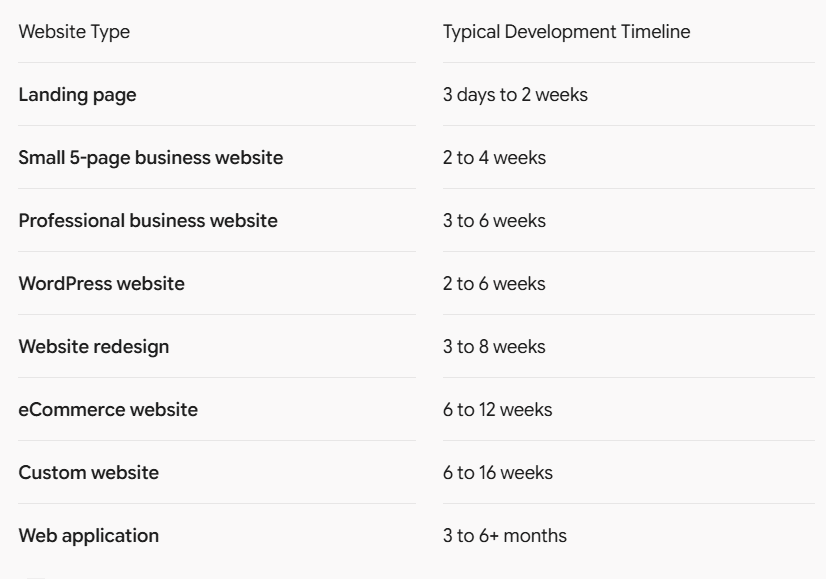
Website type | Estimated development time |
|---|---|
Simple landing page | A few days to 2 weeks |
Small business website | 2–6 weeks |
WordPress website | 2–6 weeks |
eCommerce website | 6–12 weeks |
Custom website | 6–16 weeks |
Web application | 3–6 months or longer |
The ranges used in this guide assume a dedicated project team, reasonably clear brief, and prompt client feedback and approvals. If content, decisions or approvals are delayed, then the timeline naturally extends.
These are general industry planning ranges. Actual Hexaloop project timelines depend on scope, functionality, content readiness and approvals.
There is also some overlap between these categories as WordPress describes the technology while business website describes the purpose, and custom website describes the level of customization.
For example, a business website can be built with WordPress, a WordPress website can be highly customized and an eCommerce business website might use WordPress and WooCommerce, or it might require a completely custom platform.
What matters is the actual work involved.
What does a Website Development Timeline look like?
Many website projects follow the same development cycle. Some stages are skipped for a small project, while large-scale applications or custom developments take much more time and effort.
1. Planning and Discovery (2 to 5 days)
The first step is deciding what needs to be built.
This covers:
Website goals
Target audience
Required pages
Features and integrations
Sitemap and navigation
Technical requirements
Content requirements
Getting those decisions made early gives the development team a stable starting point.
2. Content and Structure (2 to 7 days)
The website project team works on structuring the information and preparing the content for development.
For a small company website, this often means writing or preparing copy for 5-10 pages and gathering media.
If the client does not have the required content, this stage can be much more extended and intertwined with other stages of development.
In other words, if the project team cannot proceed due to the lack of content, the development timeline will be affected.
3. Website Design (5 to 15 days)
The design stage covers building web pages and developing website interfaces.
It is much faster for a business website that requires a homepage, an internal page design, and a few variations. More complex developments require multiple designs, responsive versions, animations, and other complex features.
Multiple design options, revisions, and iterations will prolong this stage and increase the overall cost.
4. Website Development(1 to 6 weeks)
Website development can be the fastest stage for a simple project or take the most time and effort for a custom development.
This may include:
CMS setup
Page development
Responsive layouts
Forms
Search
User accounts
Payment functionality
Third-party integrations
Custom functionality
The duration of this stage explains why many companies ask: how long does it take to build a website? When realistic timeframes are set, the development stage starts with design approval and ends when testing begins.
5. Testing and Bug fixes (2 to 7 days)
Before launching the website, the project team conducts testing to find and fix bugs. All the essential functionality is tested, including forms, website features, layout, responsiveness, browsers, integrations, content, and other elements.
Testing is often a continuous process that spans multiple project stages. However, it always prolongs the development timeline, as bugs need to be fixed before the website goes live.
6. Website Launch( 1 to 2 days)
The launch of a website project can be the simplest part of development. It covers the final project review, production deployment, domain management (if necessary), and other closing procedures.
However, the duration of this stage rarely impacts the overall website launch timeline.
How long does it take to build different types of websites?
A simple page, a five-page website, or an eCommerce store with hundreds of products has different requirements. These are just a few examples of how long it takes to build a website.
How long does it take to build a landing page?
A simple website page can take 3 days to 2 weeks to build. It depends on the complexity of the design, the features needed, and the availability of content and approvals.
Some landing pages only require a few hours of development. They have a clear objective (e.g., generate leads or promote a product), a basic design (usually provided by a client), and limited features (e.g., one form and a CTA button).
More complex landing pages have custom illustrations and animations, advanced functionality (e.g., integration with marketing tools), and take much longer to develop. The most extensive projects require multiple revisions and approvals.
How long does it take to build a business website?
A business website often takes 2-6 weeks to build. It depends on the number of pages, features, technology used, and the client’s input.
A website with 5 pages (a homepage, an About page, Services, Contact page, and Blog) and standard functionality can be simpler than a professional website. The latter requires more time and effort to build, have custom features, and target a specific audience.
For a professional business website with more pages, custom layouts, lead-generation features, SEO friendly, or custom integrations, 3 to 6 weeks is a more useful planning range.
Website development creates the technical foundation, but ongoing search visibility usually requires a separate SEO and digital marketing strategy.
How long does it take to build a WordPress website?
A WordPress website usually takes 2-6 weeks to build. It depends on whether the project uses a WordPress theme or requires custom coding. It also depends on the number of features and the complexity of the design.
A WordPress theme rarely takes much time and money to build. However, a custom WordPress website with bespoke coding, themes, plugins, and integrations is a bigger project.
How long does it take to build an eCommerce website?
An average eCommerce website takes 6-12 weeks to build. It depends on the number of products, features, technology, and the client’s input.
An online store usually has a product catalog with multiple product pages, a shopping cart, a checkout system, payment processing, shipping options, taxes, customer accounts, order management, and other features.
All these features take time to develop, test, and debug. Testing is even more critical for an eCommerce website because it requires much more functionality to work correctly. One bug in the payment system means website visitors cannot purchase products.
How long does it take to build a custom website?
A custom website typically takes 6-16 weeks to build. It depends on the complexity of the design and developments, as well as the available resources.
In this context, a custom website means a project that requires bespoke coding, design, or functionality. However, a custom WordPress website rarely takes that long to build.
A website with a custom design and no functionality changes rarely requires much time and effort. A complex website with multiple user roles, advanced features, and third-party integrations takes much longer to build.
How long does it take to build a web application?
A web application usually takes 3-6 months to build. It depends on the complexity of the application and the required technology.
A web app typically has more robust features than a simple website. It often requires databases to store information, a user account system with permissions, dashboards, and other features.
At this stage, it becomes more useful to think about what the system needs to do rather than simply counting pages. If you're unsure whether you need a website or a web application, read our guide to website vs web application.
Why can one website take 2 weeks and another – 3 months?
Consider two different scenarios.
Project 1: A small consulting business
Five pages
Existing brand guidelines
Client provides all content
Standard contact form
WordPress
One design direction
One revision round
If decisions made quickly, this could realistically move from kickoff to launch in around 2 to 3 weeks.
Project 2: A growing eCommerce company
40+ product pages
Custom design
Product filtering
Online payments
Shipping integration
Customer accounts
CRM integration
Custom product data
Multiple stakeholders reviewing the work
That project could reasonably take 2 to 3 months.
Both are websites, but they serve different purposes and have different requirements.
One observation that comes from these examples is that time spent waiting can be as valuable as time spent working on a project. Website developers can build a page in one or two days. However, if a page has to wait for approval or content for a week, the project schedule will still be affected.
Factors Affect Website Development Time
Most website projects take longer than expected due to a few common factors.
Project complexity
Some projects require more time and effort to build a website. A simple contact form rarely takes more than a day to build. However, a multi-step calculation form with CRM integration can take much longer.
This applies to other features and functions. The complexity of development tasks is often invisible on the surface but still impacts the bottom line.
Content
Content often dictates the website development timeline. It has to be created before it can be added to a website, which means that it prolongs the development schedule.
The content can also be a limiting factor during development. If the project team cannot proceed due to the absence of required information, they may have to halt multiple stages of development.
Design revisions
The design of a website rarely survives multiple iterations without significant changes. At the same time, changes to website templates require time and effort.
A single design version approved by the client is much faster than multiple design concepts and extensive revisions.
Design feedback is also streamlined if there is one person who can approve design changes.
Third-party integrations
Websites often rely on external tools and applications. They range from CRMs and payment systems to booking systems and email marketing services. Each of these tools requires additional development time and effort to integrate.
Approval process
If a project involves multiple stakeholders, ask them to establish a fast-track approval process before development begins. Otherwise, a project can be delayed because several people have to agree that the project is ready.
Before starting a website project, it is also important to understand the developer's scope, process, ownership terms and expected timeline. See our website developer hiring checklist for questions to ask before signing a project.
How long does it take to publish a website?
Publishing a website can take anywhere between few hours to a few days once it's fully developed, tested and ready to go live. If the site is still in the design & development phase then publishing could take several weeks or even longer depending on the project.
The time required to publish a website will vary depending on site completions and whether the domain, hosting, SSL certificate and content are ready.
A website that finished development and testing could be ready to go live as soon as the production environment is configured. On the other hand a website that's still awaiting client approval, final content or third party integration validation will require additional time before it can go live.
What can affect website publishing time?
Several factors determine how quickly a completed website can be published:
Hosting and domain configuration: the hosting environment and domain settings need to be correctly configured.
SSL certificate: HTTPS must be configured and verified so that visitors can access the site securely.
Final content and approvals: all text, images and other website assets must be approved prior to going live.
Functional testing: key features, forms and integrations need to be tested prior to the site going live.
Analytics setup: Website analytics should be set up and tested where necessary.
At Hexaloop the publishing timeline is dictated by the project's readiness and the client's own requirements. We'll handle the hosting, domain and SSL config as and when needed to ensure the site is ready to go live.
The key point is that publishing a website is the very last stage in the process of making a website available on the internet. It is not the whole website development process.
How long does it take to deploy a website?
Website deployment can take between few hours to a few days for a complete website, depending on the complexity of the site, the infrastructure involved and the deployment requirements. Complex websites and web applications will take longer as they will require more time for configuration, integration checks and production testing.
Deployment is the technical process of taking a website or web application from its development or staging environment and getting it into the production environment where users can then access it.
For a custom coded site the deployment is not just about uploading the files. You have to make sure the production environment is set up correctly and that the site works as it should once it's been released.
What Happens During Website Deployment?
When you deploy a website, you make it live on the internet so users can visit it. First, you upload your website files to a web server. This might be done with FTP, SSH, or a hosting control panel.
Next, you set up the server. You need to install required software, set file permissions, or create databases. You also need to update configuration files so your site works in its new home.
Then, you test the website. You check if all pages load properly, forms work, and links go to the right places. If you find problems, you fix them and test again.
Finally, you point your domain name to the new server. Then users reach your site by typing address in their browser. Once the changes spread across the internet, your website is live for everyone.
A typical website deployment process includes the following steps:
1. Hosting and production environment configuration
The production environment has to be ready to run the website. That will involve setting up the server, the application environment, the database and all the other dependencies that the project requires.
2. Domain and SSL configuration
The domain must point to the correct production environment and the SSL certificate must be configured to support HTTPS.
3. Production deployment
The website code and assets are deployed to production. Where applicable (i.e. applications with databases, integrations etc) the appropriate configuration for the environment is also applied.
4. Functional and responsive testing
After deployment the team will check that the site works correctly in production. This will involve key functionality, mobile responsiveness and any relevant third party integrations.
5. Analytics configuration
Analytics (ex: Google Analytics) tools are set up and checked to ensure that we can measure website traffic, events and relevant user activity.
At Hexaloop deployment is part of our website development and delivery process. On a project by project basis we will also be responsible for hosting, domain and SSL setup and then of course the functional and responsive testing prior to the site being handed over or made available to the end users.
The actual time it takes to deploy will depend on the readiness of the production environment, the complexity of the site and whether any of the external services in use need to be verified.
How long does it take to launch a website?
A website launch generally involves the final bits of work to get it ready for the target audience. If development is complete and all the required configuration and approvals are in place then it could be as little as a few hours to a few days. If content is still pending, client approvals are still outstanding or there are third party integrations to be completed then it will of course take longer.
Website deployment is a technical step but website launch is the wider process of getting the site ready for real users and ensuring that it's actually ready for the public to use.
For instance a site could be successfully deployed to production and yet still require final content approval, responsive testing, analytics checks and/or key user journey validation before the team will consider it launch ready.
Website Launch Checklist
Before they launch a website Hexaloop have a number of checks in their workflow, depending on the project.
Final functional testing: check the key website features, forms and user interactions.
Mobile and responsive testing: ensure the site displays and works correctly on all relevant screen sizes.
Content approval: Confirm that the required text, images and other content are all ready for publication.
Domain and SSL verification: Ensure the domain resolves and the site is accessible via HTTPS.
Third party integration checks: Check the third party integrations that are critical to the site's functionality (payment related where applicable).
Redirects and URL checks: where appropriate check the redirects and key URLs (especially when you're replacing or migrating an existing site).
Analytics setup: Ensure that analytics is in place where required to track website traffic and relevant interactions.
Client approval: Get the requisite approval prior to the site going live to the intended audience.
What can delay a website launch?
Website launches are frequently delayed by things that are beyond the control of the dev team. Typical examples would be late client feedback, content/images not being ready, changing requirements and delays with third party integrations/verification.
For projects that use payment gateways or other external services, verification will often be required prior to the relevant functionality being able to be used in production.
Plan for these dependencies early, finalise the requirements and get the content and approvals in place on time to avoid un-necessary delays.
At Hexaloop we go through the requisite testing, configuration and approval stages to get each site ready for launch. The timescale is dependent on the project's scope and the project's readiness rather than a set number of days for every site.
How long do website projects take at Hexaloop?
At Hexaloop development times are project dependent. It will be dictated by the type of project, the level of functionality required, the amount of integration needed and the time required for feedback and approvals.
As a general plan, a business and marketing websites would be 3–6 weeks, a custom web app would be 2–4 months. These are the overall project times from kick-off to launch, not just the development time.
Our process is discovery and requirements gathering, UI/UX design, content creation, development, third party integrations, testing and deployment. On a project by project basis we'll also be responsible for hosting, domain and SSL setup and then of course post launch support.
Real Project Example: Custom E-Learning Platform
Hexaloop developed a custom e-learning platform for a coaching institute. The project took around 10 weeks to complete (including payment integration).
Client feedback and payment gateway verification added about a week to the timeline.
This project is a good example of why the time taken to develop a website is not just a function of the amount of code. Custom functionality, third party services and the time required to get feedback or to complete any external verification can all have a bearing on the final launch date.
For any project involving payment integration, time needs to be budgeted for verification and testing. Getting the requirements finalised early, providing feedback quickly and completing the third party verification on time will all go a long way to minimising delays.
How to Keep Your Website Project on Schedule
Based on the requirements and dependencies involved in website projects, the following practices can help keep development on track:
Finalise the scope early: agree on the number of pages, the features and the integrations before you go too far down the development path.
Prepare content in advance: provide the approved text, images and other assets in accordance with the project schedule.
Provide timely feedback (review designs and development milestones as and when they are produced) to avoid the kind of lengthy waiting periods that can be so frustrating.
Plan for third party integrations (identify the payment gateways and other third party services early and account for their verification requirements).
Include testing and launch preparation (time for functional testing, responsive testing, configuration and client sign off rather than just treating the launch as the inevitable final step).
If you're looking at a business website or a bespoke web app then the best way to work out your development timescale is to define the scope of the project, identify the dependencies and set clear approval gates prior to development commencing.
How can I speed up the website development process?
If you want to know how to make website development faster, focus on reducing delays. Website developers cannot work significantly faster than they already do. But you can reduce the time spent waiting for approvals or content.
Speed up website development by:
Finalize the requirements early.
Preparing content before development begins
Having one person who can approve changes
Compiling feedback at the end of a project stage
Identifying necessary integrations
Using the simplest appropriate technology
Faster projects typically happen when fewer things can slow them down.
How do you estimate website development time?
A realistic estimate of how long it will take to build a website considers five key factors:
Pages + design complexity + functionality + integrations + approval time.
To estimate how long it takes to build a website, consider the following:
Determine the number of page templates and layout variations
List all functions and features that require custom coding
Add time for content creation and approvals
Consider design complexity (landing pages are often faster to build than product pages)
Account for additional features or third-party software
That gives you a rough idea of how long it takes to build a website of a given complexity.
Timeline and budget are closely connected. If you're also comparing website development prices, see our guide to website development cost.
Not sure which type of website you need?
Share your requirements with Hexaloop and we'll help you determine the appropriate website type, functionality, technology and estimated timeline.
Why Work With Hexaloop for Website Development?
Hexaloop is a trusted website design and development company that creates responsive, SEO-friendly, and high-performance websites for startups & all types of businesses.
Our services include:
Business Website Design
E-Commerce Website Development
Custom Website Development
Responsive Website Design
Website Redesign Services
SEO-Friendly Website Development
Website Maintenance
Whether you need a simple business website or a complex e-commerce platform, Hexaloop delivers secure, scalable, and conversion-focused solutions on time and within budget.
Frequently Asked Questions
How long does a 5-page website take to build?
A simple 5-page website can take 2-4 weeks to build. It depends on functionality, design complexity, and whether the content is ready or has to be created.
Can a website be built in two weeks?
Yes, a small project with a clear brief, existing content, no complex functionality, and quick approvals can be built in 14 days.
Want to see examples of websites and digital products hexaloop delivered? Explore our website development projects.
Why does website development take so long?
Website development only covers one part of a larger project. Content creation, design, functionality, third-party software, approvals, and testing add up and affect the final timeline.
Conclusion
So, how long does it take to develop a website?
For a typical business website, plan for around 3–6 weeks. A simple landing page may take only a few days to two weeks, while ecommerce websites, custom websites and web applications can take several months depending on functionality and integrations.
The most useful way to estimate a website timeline is to look beyond page count:
Pages + design complexity + functionality + integrations + content + approval time = realistic project timeline
If you're planning a new website, Hexaloop can review your requirements and provide a project scope, estimated timeline and development plan.