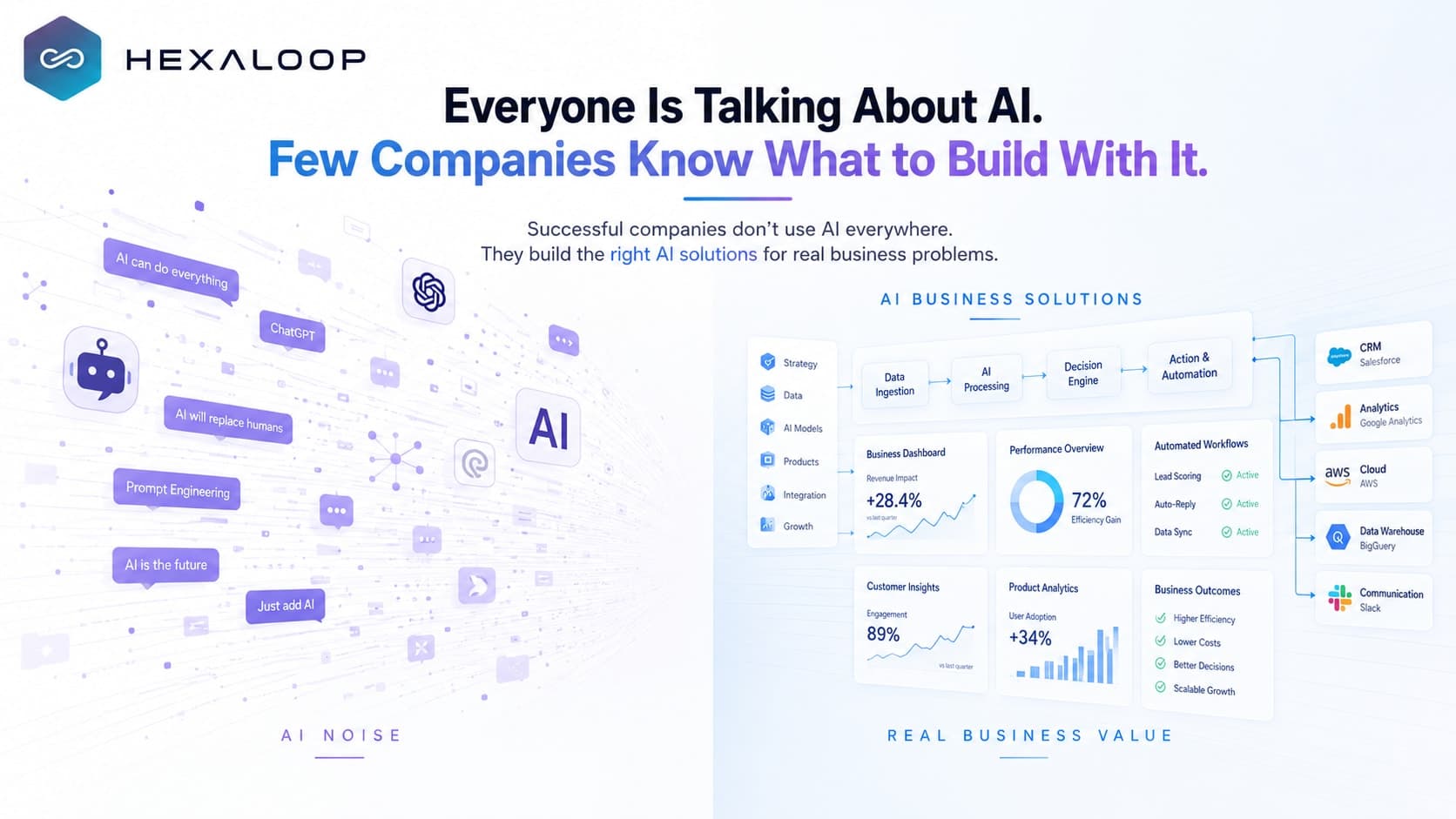
Everyone Is Talking About AI. Few Companies Know What to Build With It | AI Software Development for Businesses
Discover how AI software development is helping businesses reduce costs, automate operations, and build better products in 2026 without falling for the hype.
A surprising high number of companies claim they're "AI-powered".
Take a closer look, and you'll see the same thing time and time again: a chatbot on the website, an AI content generation, or a couple of automatic emails.
That's not a business strategy.
Companies that really see business value from AI are using it to address expensive business problems.
A retail company uses AI to predict the future sales of their products instead of overstocking inventory.
A SaaS company reduces support tickets by letting customers find answers instantly.
A manufacturing company detects machinery issues to prevent production downtime.
See the pattern?
They're not buying AI solutions because they are cool. They are building software that helps them to make better decision, act faster, and automate repetitive work.
If you're wondering whether your business should build AI software or where to even begin this article is for you.
AI Software Development Isn't About AI. It's About Solving Problems.
Many businesses start with the wrong question.
"How can we use AI?"
A better question is:
"What's slowing our business down today?"
That's where AI software development begins.
At its core, AI software development is the process of building applications that can learn from data, understand patterns, automate decisions, or interact naturally with users.
The technology matters.
But the business outcome matters more.
Think about invoice processing.
In many companies, employees still spend hours downloading invoices, checking purchase orders, approving payments, and correcting errors.
An AI-powered system can read invoices automatically, match them against internal records, flag unusual transactions, and send only exceptions to a finance manager.
The software hasn't replaced the finance team.
It has removed the work nobody enjoys doing.
That's what good AI software looks like.
Why 2026 Feels Different
A few years ago, AI was mostly viewed as an experiment.
Companies were testing chatbots, running small pilots, and exploring possibilities.
Today, AI is becoming part of everyday business operations.
Why?
Because customer expectations have changed.
People expect software to understand their needs.
They expect instant answers.
They expect personalized recommendations.
They expect digital experiences that feel intelligent.
These expectations are no longer considered advanced features. They are becoming the standard.
Businesses that deliver these experiences gain an advantage.
Businesses that ignore them risk falling behind.
AI has moved from being a technology experiment to becoming a business strategy.
The Biggest Mistake Companies Make
Here's something that rarely gets discussed.
Many AI projects don't fail because the technology is bad.
They fail because businesses try to solve too many problems at once.
A company decides it wants AI.
Suddenly there's an AI chatbot, an AI dashboard, AI-powered reporting, AI marketing automation, and AI analytics—all launched within a few months.
The result?
Higher costs.
Confused employees.
Poor adoption.
Very little business impact.
The most successful AI projects usually start much smaller.
One problem.
One measurable outcome.
One successful implementation.
Then they expand.
That's far less exciting than announcing an "AI transformation."
It's also far more effective.
Start small. Solve one important problem. Measure the result. Expand from there.
Where AI Creates the Most Business Value
Not every process needs artificial intelligence.
But some are perfect candidates.
Customer Support
Most support teams answer the same questions repeatedly.
Where is my order?
How do I reset my password?
Can I change my subscription?
AI can resolve these requests instantly while routing complex conversations to human agents.
Customers get faster answers.
Support teams spend more time solving problems that actually require expertise.
Everyone wins.
Sales and Marketing
Sales teams already have more leads than they can realistically follow up with.
AI helps prioritize the right ones.
Instead of treating every lead equally, AI can identify which prospects are most likely to convert based on previous buying patterns, website activity, and engagement.
Marketing teams benefit too.
Rather than sending the same campaign to every customer, they can deliver personalized recommendations that feel relevant instead of random.
Operations
If you've ever looked at an operations dashboard with hundreds of rows of data, you know the challenge isn't collecting information.
It's knowing what matters.
AI helps businesses identify patterns humans often miss.
It can predict inventory shortages, detect unusual transactions, forecast demand, and identify operational bottlenecks before they become expensive problems.
That's where the real value lies.
Not in creating more reports.
In creating better decisions.
Build AI Software or Buy an Existing Tool?
This is one of the most important questions a business can ask.
And the answer isn't always "build."
If your goal is writing marketing copy, generating meeting notes, or improving team productivity, existing AI platforms are often enough.
Building custom software for these tasks rarely makes financial sense.
Custom AI software becomes valuable when your business has something unique.
Building a custom solution makes sense when:
Your workflows are highly specialized.
Your competitive advantage comes from proprietary data.
You need AI deeply integrated with existing systems.
Security, compliance, or scalability requirements cannot be met by standard tools.
A simple rule:
Buy what everyone needs. Build what makes your business different.
Signs Your Business Is Ready for Custom AI Software
Not every company is ready for a large AI investment.
The businesses that succeed usually have a few things in common.
You may be ready if:
Your team spends hours on repetitive manual work.
You collect valuable business data but rarely use it.
Customers expect faster, more personalized experiences.
Your software no longer supports how your business operates.
Growth is increasing operational complexity.
If several of these sound familiar, AI may already have a clear business case.
Choosing the Right AI Development Partner
Many businesses compare development companies by hourly rates.
That's understandable.
It's also one of the quickest ways to choose the wrong partner.
The better question is:
Do they understand the business problem, or are they only talking about technology?
A good AI development partner should spend more time asking questions than showing demos.
They'll want to understand:
Your business goals
Existing workflows
Available data
Success metrics
Long-term growth plans
A good partner doesn't simply build AI features.
They help identify where AI will create the highest return.
What AI Can't Do
AI is powerful, but it isn't magic.
It won't fix broken processes.
It won't replace business strategy.
It won't create value without quality data and clear goals.
The companies achieving the best results aren't replacing human expertise with AI.
They're combining:
Human decision-making
Business knowledge
Intelligent automation
Data-driven insights
The future isn't humans versus AI.
It's humans using AI effectively.
What the Future of AI Software Development Looks Like
The AI conversation is changing.
Businesses are moving beyond:
"Can we use AI?"
They're asking:
"Which parts of our business should become smarter?"
AI is already helping companies:
Automate workflows
Analyze customer behavior
Improve software development
Predict business outcomes
Create personalized experiences
The biggest shift isn't only technological.
It's strategic.
Companies that learn how to combine human expertise with AI capabilities will move faster than those waiting for the "perfect time" to start.
Frequently Asked Questions
Is AI software development only for large enterprises?
No. Cloud platforms and pre-trained AI models have significantly reduced development costs. Many startups and mid-sized businesses are now building AI-powered products that were once only possible for large enterprises.
How long does an AI software project take?
It depends on the complexity of the problem. A focused AI feature may take a few weeks, while a custom enterprise solution can take several months. Starting with a small pilot often leads to faster results and lower risk.
Should we replace our existing software with AI?
Usually not. In many cases, the best approach is to enhance your existing systems with AI capabilities rather than rebuilding everything from scratch.
Can AI replace software developers?
AI is becoming an excellent assistant for developers, but it still relies on human expertise for architecture, security, business logic, and product strategy.
What's the biggest mistake companies make?
Trying to implement AI everywhere at once. Businesses see better results when they start with one high-impact problem, measure the outcome, and expand from there.
Key Takeaways
AI software development is most valuable when it solves a clear business problem—not when it's added for the sake of innovation.
Start with one measurable use case instead of trying to transform the entire organization.
Custom AI software makes sense when your workflows or data create a competitive advantage.
The right development partner should understand your business before recommending technology.
AI works best as a tool that strengthens human decision-making, not as a replacement for it.
Ready to Find Where AI Can Create Value for Your Business?
AI adoption doesn't start with choosing a technology.
It starts with identifying the right opportunity.
Whether you want to automate internal processes, build an AI-powered product, or enhance existing software with intelligent features, the first step is understanding where AI can deliver measurable impact.
Talk to our AI specialists today to explore your AI software development opportunities and discover what you can build next.
Final Thoughts
Five years from now, customers won't ask whether your product uses AI.
They'll simply expect it to be faster, smarter, and easier to use than the alternatives.
That's why AI software development isn't really about artificial intelligence.
It's about removing friction.
It's about helping employees spend less time on repetitive work and more time solving meaningful problems.
It's about giving customers better experiences without increasing operational complexity.
The companies leading in 2026 aren't chasing AI headlines. They're quietly building software that solves problems their competitors still handle manually.
And that's where the real competitive advantage begins.
You Might Also Like
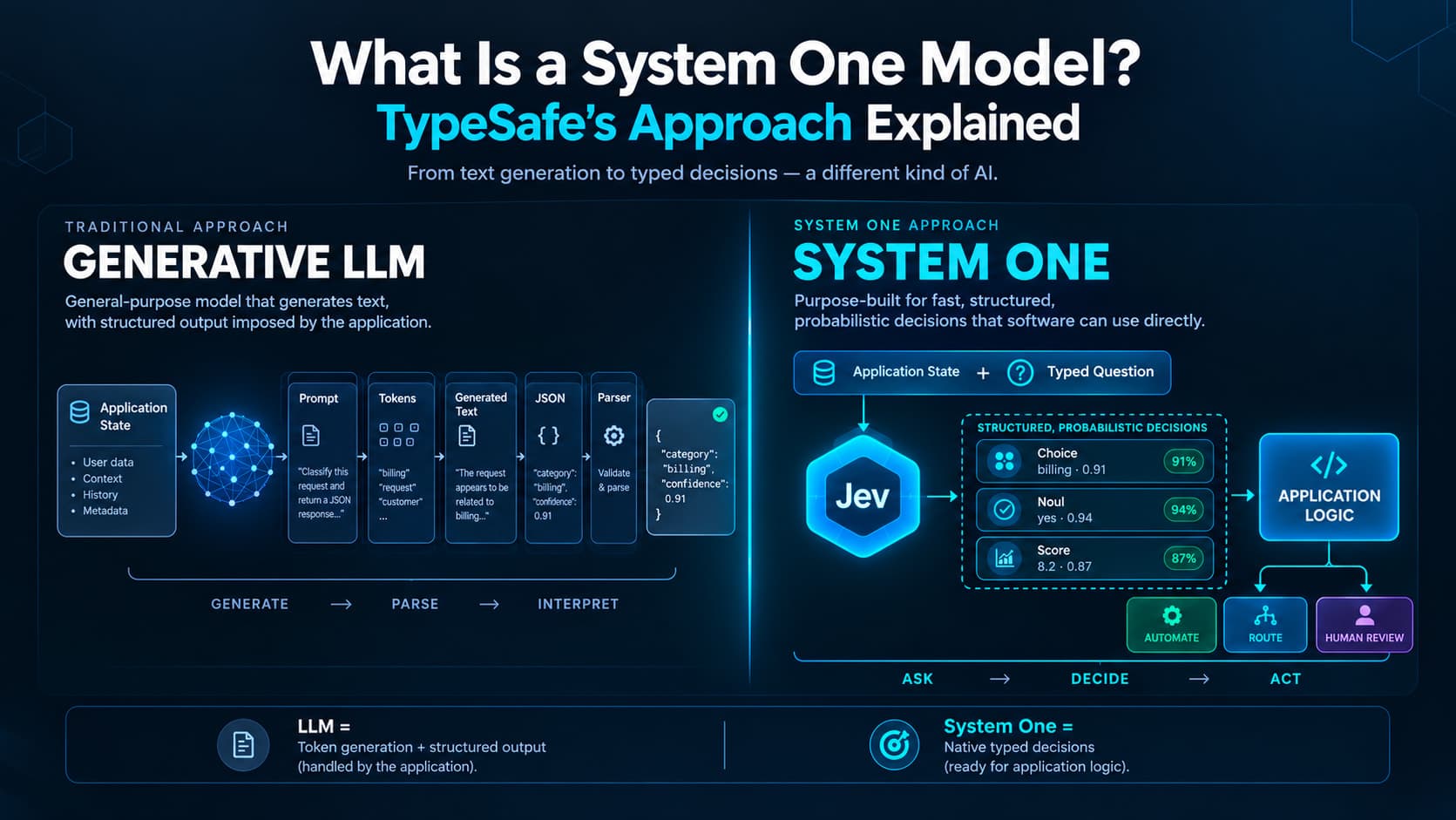
What Is a System One Model? TypeSafe's Approach Explained