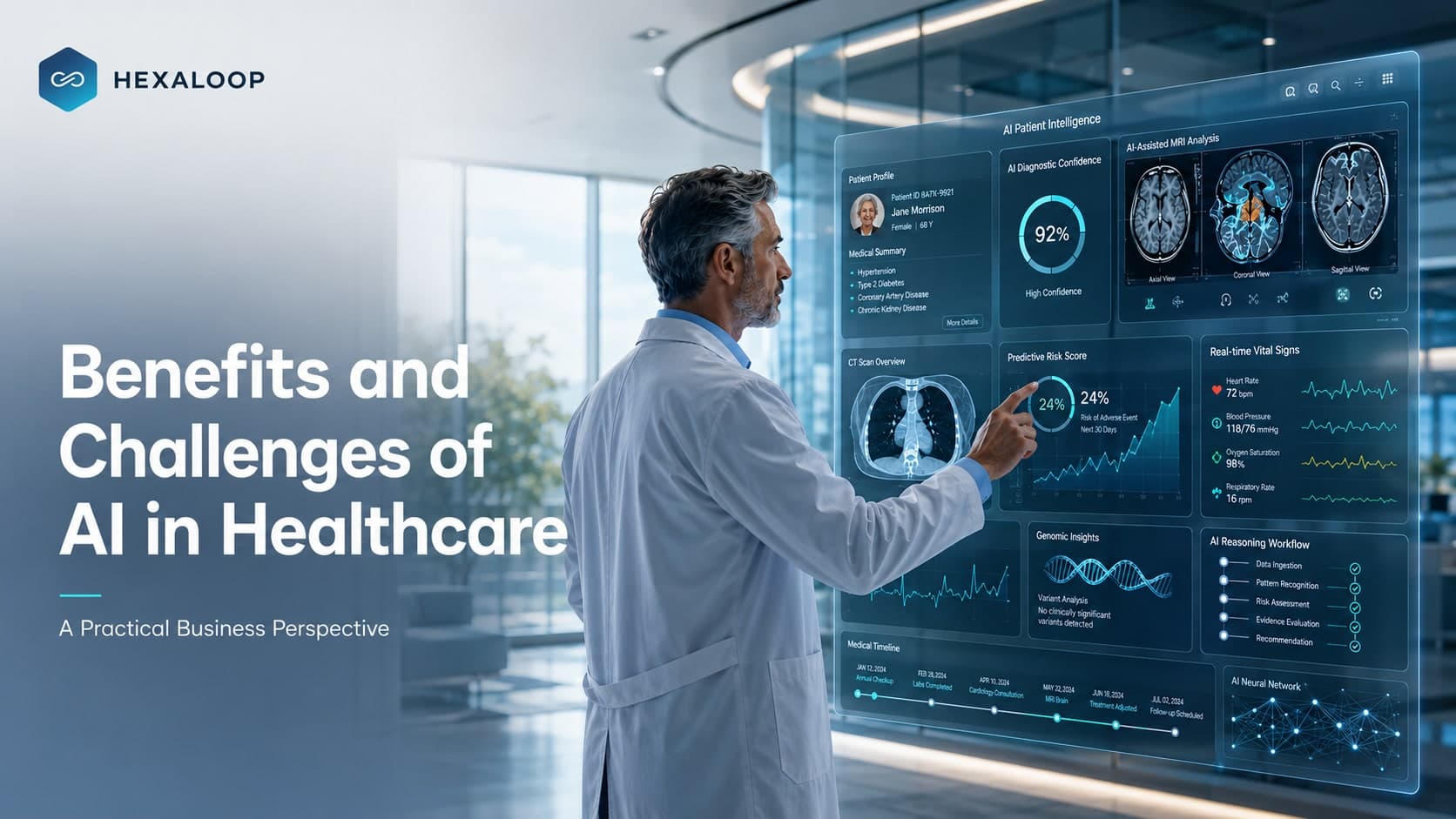
Benefits and Challenges of AI in Healthcare
Explore the benefits and challenges of AI in healthcare, practical use cases, risks, and implementation strategies for healthcare businesses
Healthcare organizations rarely fail because they choose the wrong AI model.
They fail because they solve the wrong problem.
A hospital invests in an AI-powered diagnostic tool but forgets that clinicians don't trust black-box recommendations. A healthcare startup builds a brilliant prediction engine, only to discover its patient data is fragmented across five legacy systems. Another launches an AI chatbot that patients ignore because it answers questions but not the ones people actually ask.
This is why conversations about Benefits and Challenges of AI in Healthcare often miss the point. The discussion shouldn't start with algorithms. It should start with workflows, trust, regulations, and measurable business outcomes.
Organizations that understand this distinction aren't simply "using AI." They're redesigning healthcare experiences around better decisions, faster operations, and safer patient care.
That's where the real opportunity begins.
AI in Healthcare Isn't About Replacing Doctors
One of the biggest misconceptions surrounding AI in Healthcare is that machines are replacing medical professionals.
Reality looks very different.
The strongest AI systems remove repetitive work so clinicians can focus on complex decisions that require judgment, empathy, and experience.
Think about how much time healthcare teams spend on documentation, appointment scheduling, coding, prior authorizations, and reviewing medical images. Many of these tasks are rule-driven, repetitive, and data-heavy—the exact type of work AI handles well.
Healthcare improves not because AI becomes smarter than physicians.
It improves because physicians spend more time practicing medicine.
The Real Benefits of AI in Healthcare
Not every AI initiative produces value.
The successful ones usually improve one of three things:
Decision quality
Operational efficiency
Patient experience
Everything else is secondary.
1. Earlier and More Accurate Clinical Decisions
AI excels at identifying patterns across massive datasets.
Radiology, pathology, dermatology, and ophthalmology are strong examples where AI can assist clinicians by highlighting abnormalities that deserve closer review.
The goal isn't replacing expertise.
It's reducing the chance that critical findings are overlooked during busy clinical workflows.
2. Better Operational Efficiency
Many healthcare executives underestimate how much money disappears into inefficient administrative processes.
Examples include:
Insurance verification
Medical coding
Appointment scheduling
Clinical documentation
Resource allocation
Automating these processes often delivers a faster return than investing in highly sophisticated clinical AI.
Sometimes the best healthcare AI project doesn't touch patients directly.
It fixes the back office.
3. More Personalized Patient Care
Healthcare has traditionally relied on standardized treatment pathways.
AI enables organizations to move toward individualized care by combining medical history, genetics, wearable data, medications, and lifestyle information into more informed recommendations.
Personalization becomes practical—not theoretical.
4. Smarter Remote Patient Monitoring
Chronic disease management changes dramatically when AI continuously analyzes patient data instead of waiting for the next clinic visit.
Instead of reacting after symptoms worsen, providers receive alerts earlier.
That shift from reactive to proactive care can improve both patient outcomes and operational efficiency.
5. Faster Drug Discovery and Research
Drug development has always been expensive and time-consuming.
AI helps researchers prioritize promising compounds, analyze biological data faster, and reduce repetitive research tasks.
It doesn't eliminate scientific validation.
It simply helps scientists spend less time searching and more time testing.
The Challenges of AI in Healthcare Are Usually Business Problems
The conversation often focuses on technical complexity.
Yet many Challenges of AI in Healthcare have little to do with machine learning itself.
They involve people, governance, regulations, and organizational readiness.
Challenge #1: Data Quality Determines Everything
Healthcare data rarely lives in one clean database.
It exists across:
Electronic Health Records
Imaging systems
Laboratory platforms
Wearable devices
Insurance databases
Legacy software
If this information is incomplete, duplicated, inconsistent, or outdated, AI produces unreliable recommendations.
Poor data quality doesn't just reduce accuracy.
It reduces trust.
Challenge #2: Explainability Matters
Imagine an AI system recommends immediate surgery.
A physician naturally asks:
"Why?"
If the system cannot explain its reasoning clearly, adoption slows—even when predictions are accurate.
Healthcare professionals need confidence, not mystery.
Explainable AI is becoming just as important as accurate AI.
Challenge #3: Clinician Adoption
Even excellent technology can fail.
Not because it performs poorly.
Because nobody wants to use it.
Healthcare professionals already navigate multiple systems throughout the day.
Adding another dashboard often creates frustration rather than efficiency.
Successful AI integrates into existing workflows instead of asking clinicians to change everything.
Challenge #4: AI Isn't a One-Time Project
Many executives think AI deployment is the finish line.
It's actually the starting point.
Models require:
Monitoring
Retraining
Performance evaluation
Security updates
Governance reviews
Healthcare environments evolve continuously.
AI must evolve with them.
Benefits and Challenges of AI in Healthcare: A Decision Framework
Where Businesses Commonly Go Wrong
The biggest mistake isn't choosing the wrong AI model.
It's choosing AI before understanding the workflow.
Consider two projects.
Project A
A hospital invests heavily in predictive analytics.
Nobody uses it because recommendations arrive after clinical decisions have already been made.
Project B
Another hospital automates appointment scheduling, documentation assistance, and patient triage before expanding into clinical AI.
The second organization usually sees measurable returns much earlier.
The lesson?
Solve operational friction before pursuing sophisticated intelligence.
Building AI That Healthcare Professionals Actually Trust
Trust isn't created by marketing.
It's earned through consistency.
Healthcare AI should be:
Transparent
Secure
Explainable
Human-supervised
Continuously monitored
The organizations seeing the greatest success treat AI as a decision-support system rather than a decision-maker.
That's a subtle difference.
It changes everything.
Choosing the Right Technology Partner
Healthcare AI projects rarely succeed through software development alone.
They require expertise in cloud infrastructure, cybersecurity, UX design, compliance, systems integration, and long-term product evolution.
At Hexaloop, we encourage organizations to start with the business objective—not the technology stack.
Depending on your roadmap, you may benefit from:
AI Software Development for intelligent healthcare applications.
Custom Software Development when existing platforms can't support specialized workflows.
Cloud Solutions for secure, scalable healthcare infrastructure.
Mobile Application Development for patient engagement and remote monitoring.
Website Design for healthcare portals and digital experiences.
SEO & Digital Marketing to improve healthcare product visibility.
IT Consulting to evaluate technical feasibility before development.
Agentic AI Solutions for intelligent workflow automation and autonomous healthcare operations.
The strongest healthcare platforms are built by combining these capabilities rather than treating AI as an isolated feature.
Key Takeaways
AI delivers the most value when it solves workflow problems before technical ones.
Data quality is the foundation of every successful healthcare AI initiative.
Explainability is just as important as prediction accuracy.
Compliance should influence architecture from day one.
Healthcare professionals must trust AI before they adopt it.
Operational automation often produces faster ROI than advanced clinical AI.
AI requires continuous monitoring after deployment—not just implementation.
Frequently Asked Questions
What are the benefits of AI in healthcare?
The primary benefits include improved clinical decision support, administrative automation, personalized patient care, predictive analytics, remote monitoring, and faster medical research.
What are the biggest challenges of AI in healthcare?
Common challenges include poor data quality, regulatory compliance, cybersecurity, clinician adoption, explainability, and maintaining AI models over time.
Can AI replace doctors?
No. AI is designed to support healthcare professionals by assisting with data analysis, pattern recognition, and repetitive tasks. Medical judgment remains a human responsibility.
Is AI safe for healthcare?
AI can be safe when combined with strong governance, secure infrastructure, validated models, human oversight, and continuous monitoring.
Which healthcare areas benefit most from AI?
Radiology, pathology, patient triage, administrative automation, predictive analytics, remote patient monitoring, and clinical documentation have shown strong potential for AI adoption.
How should a healthcare business start using AI?
Start by identifying a measurable operational or clinical problem, assess data readiness, validate compliance requirements, build a pilot project, and measure outcomes before scaling.
Does every healthcare organization need custom AI software?
Not always. Off-the-shelf tools may work for common use cases. Organizations with specialized workflows, legacy integrations, or unique compliance needs often benefit more from custom-built AI solutions.
How long does an AI healthcare project typically take?
Timelines vary based on project complexity, data availability, regulatory requirements, and integration needs. Many organizations begin with a focused pilot before expanding into larger deployments.
Thinking About Your First—or Next—Healthcare AI Project?
The organizations getting the most from AI aren't chasing headlines or adding "AI-powered" to every product page. They're making deliberate decisions about where intelligence creates measurable value and where simpler improvements solve bigger problems.
If you're evaluating Benefits and Challenges of AI in Healthcare for your business, it's worth validating the opportunity before committing significant time and budget.
Whether you're modernizing a healthcare platform, building a new digital product, or exploring intelligent automation, the team at Hexaloop can help you assess the technical, operational, and business considerations before development begins.
You Might Also Like

Hiring a Website Developer in Indore? 10 Things to Check Before You Hire